
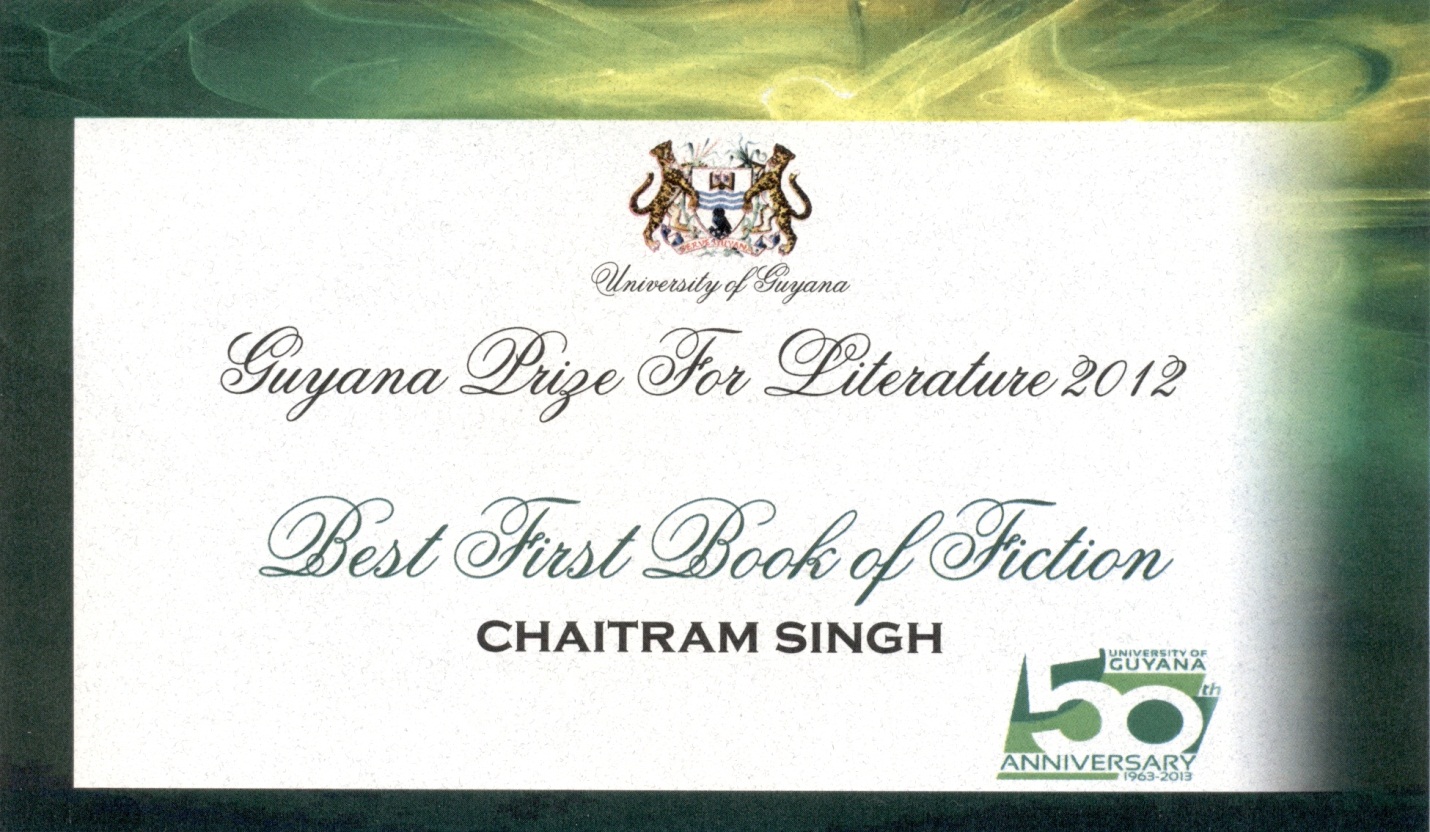
Guyana Prize for Literature (2012)
Guyana Prize for Literature 2012
Acceptance Speech, Given on Behalf of the Prize Winners
Your Excellency President Ramotar, Vice-Chancellor, Members of the Diplomatic Corps, Dr. Jane Bryce, Members of the Prize Committee, Fellow Prize Winners, Ladies and Gentlemen:
Let me begin by congratulating the prize winners and saluting those who submitted their works for consideration but did not make the final cut.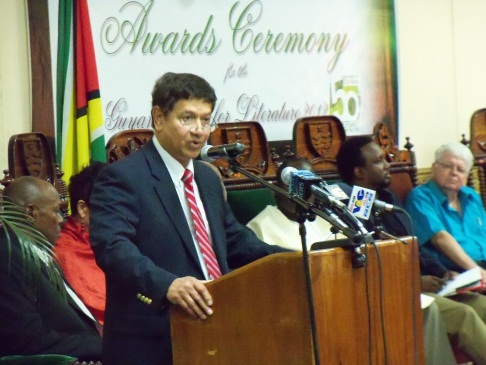
And now, on behalf of the Prize Winners, I would like to thank President Ramotar for his presence here and for his participation in this ceremony which, of course, makes it very special, but I would also like to thank him for the support his government has been giving to the arts, including support for literature in particular. I hope, and indeed it is my earnest plea, that you will continue to maintain this support and keep it on a regular schedule, preferably an annual one.
To Dr. Bryce, Chief Judge of the competition, please accept our thanks to you and your committee. As one, who has served on a book awards committee, I know that the work can be voluminous and time-consuming, even challenging, and the deliberation agonizing. Please convey to the rest of your colleagues our thanks and appreciation for their work.
To the Prize Committee, for which Ms. Debra Lowe-Thorne and Professor Al Creighton seemed to be its primary interlocutors, I wish to thank you all for the kindnesses and considerations extended to me and to the other prize winners and short-listed individuals.
And now, I am on the clock, as they say. My handlers have given me a time limit and, since I am not running for political office, I am very glad to stick to their schedule.
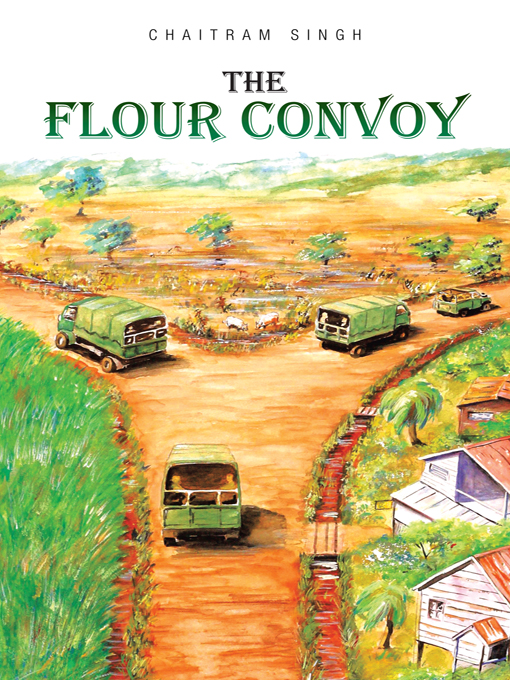
One reader of my novel, The Flour Convoy, a very well-meaning individual, after confessing how much he had enjoyed the work, asked why I wrote about Guyana, as in why the bother? Were there not more interesting subjects to write about? What can one possibly learn from Guyana? These, at least, were the inferences I drew from the original question and the expression accompanying it.
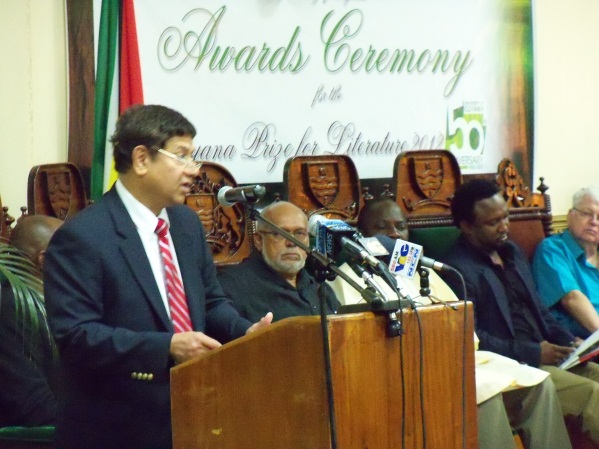
The social circumstances of the encounter did not permit a lengthy engagement on the subject and, in any case, it was clear to me that the reading of my work was a concession made by someone who had not invested much time on reading beyond the narrowest requirements of the job and, therefore, was not in a position to fully appreciate the value and contribution of literature, regardless of the origin of the writer or the geographic locale that served as the focal point of the work.
But the question exposes an attitude far too prevalent among many Guyanese and people of Guyanese origin, some supposedly of deep erudition, who believe that fine literature is only to be found elsewhere, an unfortunate residual affliction from a colonial education based on a syllabus designed by some unknown persons in Europe for exams graded by another equally unknown set of persons in Europe. This is not meant as an indictment of the content of that education, from which I benefitted immensely, but it is more of a lamentation that many educated in this manner have never fully recovered from the internalization of an evaluation system that devalues anything that is not European or that does not closely resemble what might have already been produced out of Europe. They criticize much and create little. They quote extensively from the masters but seem untransformed by the insightful declaration of Shakespeare’s Cassius: “The fault, dear Brutus, is not in our stars, but in ourselves, that we are underlings.”

For a small minority, however, works like mine, open up wounds they would rather forget. This willingness to engage in mental erasure is particularly worrisome because one can envision a time in the future when some revisionist might assert that slavery and indentureship were figments of our imagination and that people appeared in Guyana perhaps because Adam and Eve lost their way in the Garden of Eden. Presumably, they produced some of you and adopted the rest of us.
Well, not so at all! We are, in the main, descendants of slaves and indentured laborers. It is indelibly tattooed on our umbilical cords. Cuffy lived! He defeated an organized European force. We struggled for our independence, and, yes, we have undergone some growing pains. Which nation has not?

And now, I would like to address the original question posed to me and, in doing so, Mr. President, reinforce the value of the exercise we have just undergone and emphasize to you the urgent need to encourage creative writers to aggressively compete for readership as they try to tell the Guyanese story with the authenticity of voice, of time, and of place.
Why write about Guyana? Let’s ponder that for a moment, and while we do so, I ask:
Is Guyanese culture not worthy of exposition and transmission through written works?
Are not the themes of struggle, suffering, and triumph over adversity universal themes that have found expression in the works of great European writers, such as Charles Dickens and Victor Hugo, as well as in those of Third World writers such as Ken Saro-Wiwa and Chinua Achebe?
I think of Harper Lee’s To Kill a Mockingbird and I ask: Shouldn’t Guyanese writers too hold up their stories like looking glasses to confront us with the biases, prejudices, and stereotypes that have hung like albatrosses, for far too long, over necks?
No nation can progress by ignoring its own history, its own past. But that past is not simply a chronological chronicling of events. It needs to be richly supplemented by the depth of emotion that can most powerfully be captured by a country’s story-tellers, poets, artists, and musicians to produce catharsis and to inspire the drive forward for true nation-building.
The Athenian military commander and politician, Themistocles, once said: “I cannot fiddle, but I can make a great state of a small city.” The aspiration to build a great state has been a part of the vision of every benevolent, forward-looking national leader, and I am sure, Excellency, that it is your vision for this country.
But governments are conditioned by a myriad of forces, to measure success by the growth in the gross domestic product, employment figures, infrastructural works, improvements in education, health care, among others. These are vitally important indices, to be sure, but their achievement requires an inspired people, a people whose spirits find upliftment from the arduous and often dull routines of making a living, from the to-and-fro-ing from jobs they cannot connect to a grand strategy.
In this enterprise, good leadership, such as yours, Excellency, is a sine qua non, but never underestimate the inspirational force that flows from majestically crafted poetry. Think of Jose Marti and the struggle for Cuban independence; Pablo Neruda, Rabindranath Tagore, and our own Martin Carter. People need heroes, mythical figures that fiction writers can craft, to inspire the young and old alike to higher purpose.
The point here is that there is a role, and an important one, for the arts, in general, and literature, in particular, in the development process.
Your Excellency, your presence here this evening, and the sponsorship of your government for exercises such as these–for the promotion of creative writing–are clear signs that you recognize that nation-building is a more all-encompassing task than just the practical and programmatic efforts of developing a country, as important as these are.
The vision of Themistocles can happen here. It’ll be a long road but, as the old Creole saying goes, “Wan, wan dutty does build dam.” Considerable progress has already been made. The achievements of the past two decades are vast and manifest to any clear-eyed observer. And you, Excellency, will continue to build on these, I am sure.
On behalf of the Prize Winners, I wish you every success in your efforts to move this country forward.
May God bless you, and may God bless the people of this great country.
Chaitram Singh
Professor of Government & International Studies
Berry College
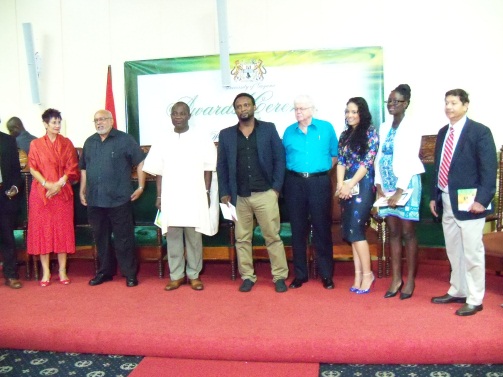

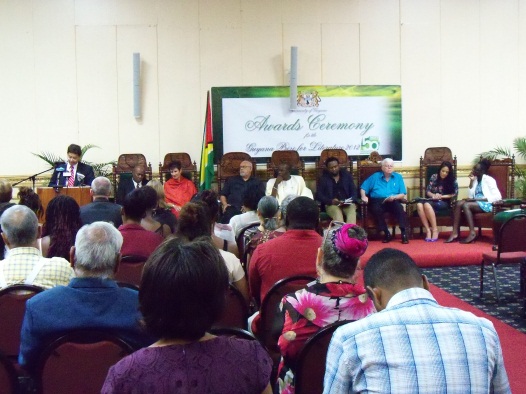

 CHAITRAM SINGH
Pingback: Guyana Prize For Literature | CHAITRAM SINGH