
The Flour Convoy
“The Flour Convoy” is a masterful weave by a writer skilled in his craft, and the reader is at once captivated and repelled by the tapestry of corruption, brutality, greed, and lack of concern for common people. A must read for anyone interested in post-colonial literature and Caribbean literature in particular.
Sarah Sooknanan
THE FLOUR CONVOY
Review by Roopnandan Singh
I have never done a written book review before, but after reading The Flour Convoy, winner of the Guyana Prize for Literature 2012 and written by Professor Chaitram Singh, I felt impelled to share my thoughts on the book.
For me the following constitute a good work of fiction:
- It must be engaging, holding your interest all or most of the time. In other words, you don’t ever feel like putting it down. You always want to know what is next.
- It’s realistic, feels like a true story, making you forget it’s a work of fiction.
- You can relate to the story in some way or another, or at least you feel as if you are on the scene, an eyewitness to what’s going on.
- If it’s a thick book, you brace yourself to go through it, yet when it’s over you wished it had more.
Well, well, well . . . What do you know?!. Turns out that The Flour Convoy is all of the above. For some Guyanese, both at home and abroad, it evokes a lot of memories and is therefore, nostalgic. Paradoxically, for many, it brings back to life some bitter days that are best obliterated from memory. And, even those in the latter group, will find it interesting to read, if only to celebrate the dawn of a new era in Guyana in 1992. In this fictionalized work of history, that captures the spirit of the time with its bit of humor and unique Guyanese culture, the plot, characterization, and style are flawless.
In today’s world, The Flour Convoy, is still relevant and, indeed, a timely reminder of what to guard against in every society.
I highly recommend Flour Convoy to all and sundry.
Roopnandan Singh
Prashad Nagar, Guyana
The Flour Convoy
Dr. Larry Marvin’s Review
Chaitram Singh’s The Flour Convoy accurately conveys a country on the brink of revolution while a corrupt government increasingly plays dirty tricks to stay in power. Through two central characters Singh shows what it means to be on both sides of the equation. The hero of the story, Captain Allan Moore, is a West Point graduate and dedicated professional officer in the Guyana Defense Force. Within his limited means, Moore tries to remain above the corruption and squalor besetting his homeland but in the end has to decide whether to stay and be permanently stained by corruption, or seek a better life somewhere else. Moore’s dilemma stands for one faced by thousands of others in Guyana at the time (ca. early 1980s). In some ways Singh’s anti-hero, the general Clive Agrippa, is a more complex character. Agrippa does not come off as a stock villain but rather as one who may have had good intentions at one time but became part of a rotten system and who uses that system for his own personal gain. Agrippa is not an evil genius; almost comically he repeatedly makes serious errors of judgment but dodges and weaves to stay in power. His success in doing so of course increasingly compromises not only the office he holds (chief of staff of the army) but undermines the army’s position as loyal, non-partisan servant to the state. Singh is particularly well placed to tell this story. A native of Guyana, he graduated from West Point and is a professor of government at Berry College. The descriptions of his homeland, life and lifestyle of professional army officers, the native dialect and dishes skillfully convey the sights, smells and sense of a place most Americans have never heard of. The author’s academic expertise and descriptive powers pull the reader in and involve us in well-drawn characters in a society on the edge. I recommend this book to those like myself who know very little of the politics, culture and society of this corner of South America. The reader gets a surprisingly engaging story and a lesson in politics and moral ethics south of the border.
Dyal (Zab) Panday’s Review of The Flour Convoy
I am writing these comments on The Flour Convoy, not as a literary critic, but as someone who is well acquainted with the historical context of the novel and one who greatly appreciates the way the novel is rendered.
For me, The Flour Convoy evokes strong feelings of nostalgia for several reasons. As a former officer in the Guyana Defense Force, which seems to be the army referenced in the novel, I could not help reminiscing about the military routines and rotational schedules so graphically depicted in the work. I was stationed at both Camp Stephenson and Camp Ayanganna and am very familiar with the Officer’s Messes at both locations, as well as the almost daily travel between these two main camps.The Messes were truly the hub of social life in the GDF, and great were the times I had at both locations. However, during the period captured by the novel, the army did play a peculiar role in the political life of the country, corrupting its professionalism and permitting some of its senior officers to act as law onto themselves. Readers would want to know I am sure, that in this work of fiction, the author accurately captures the decadent subculture of the senior officer corps, which had with open eyes become the handmaiden of a political regime. The notion of “An Officer and a Gentleman” could hardly describe those who held senior ranks in this military; rather a “crab in the barrel” attitude more accurately characterized the senior officers, who used their offices for personal gains and for acts that would on the surface appear to be unlawful. The episodes presented in this novel are perhaps much truer than the author imagined.
No single work can realistically capture the political, social, and cultural life of a country in its entirety even one as small as Guyana. Nor does that appear to be the major aim of the author. That said, Chaitram Singh cleverly interweaves elements of the Guyanese culture in the narration of this story and employs the local dialect with tremendous effect. The novel is rendered in a style that makes it easily accessible to most readers, and with a sharp wit and a briskness of pace that makes you keep reading. However, the novel’s ending forcefully reminds one of the seriousness of the message at work. The reader is very much aware of the strangled post-independence developments of Guyana which encouraged the migration of thousands to other countries.
A wonderful piece of fiction by a Guyanese-American writer.
The Flour Convoy
Review by Abel Peters
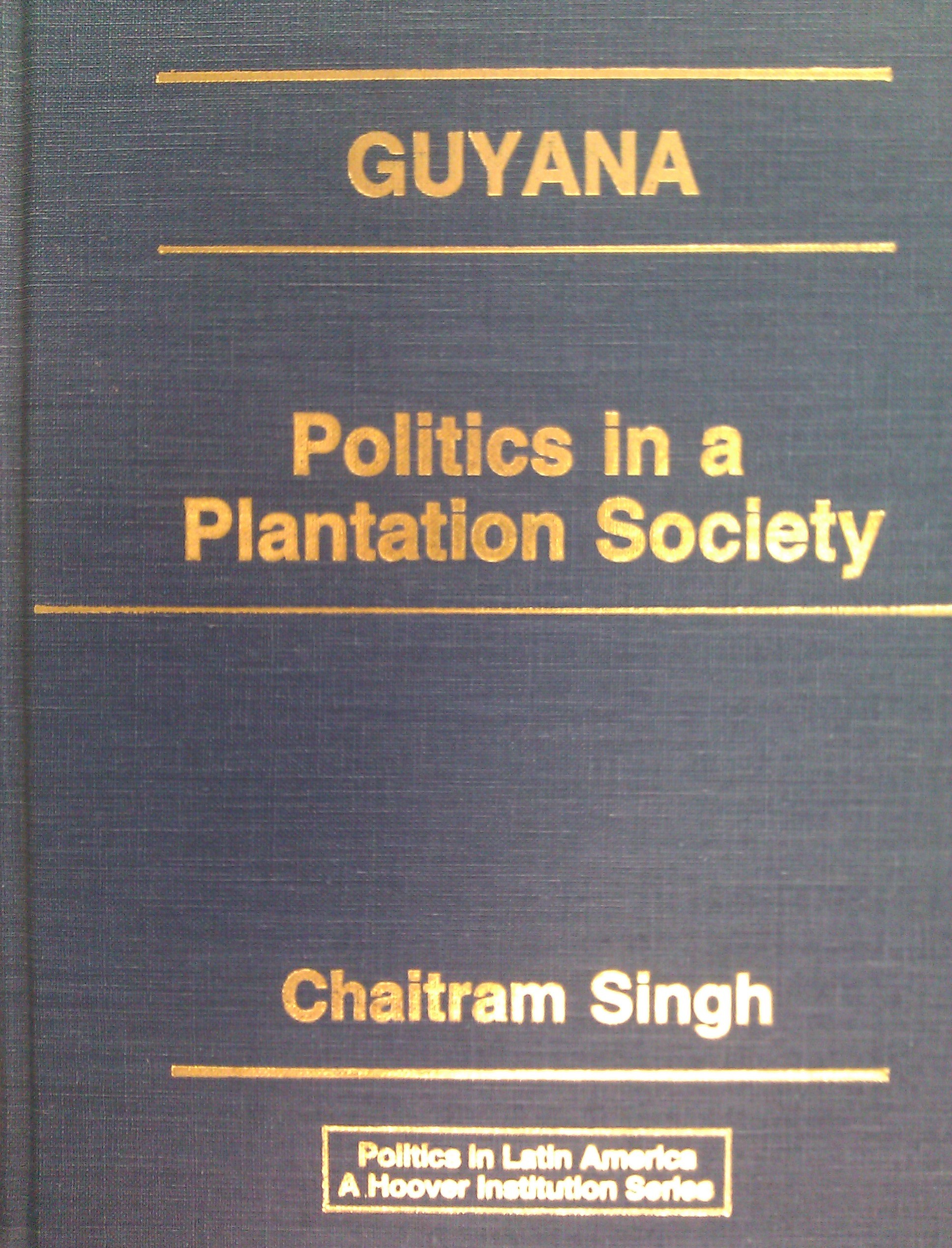
I AM writing to share some comments on the novel, The Flour Convoy, a novel by Chaitram Singh, published by the University Press of the South. This is Chaitram Singh’s first fictional work. (His earlier work was “Guyana: Politics in a Plantation Society.”) Set in the early 1980s and deriving its name from the illicit practice of the smuggling of contraband flour across the Corentyne River from neighboring Suriname, at a time when the regime of President Forbes Burnham was banning almost all imported food in its short-sighted drive to replace them with local substitutes, the book reveals an incredible pattern of fraud, corruption and murder, and the lengths to which the regime resorted in order to cling to power. Unique is the author’s bold application of the local Georgetown lingo in the dialogue coursing throughout the book – a feature that augurs well for authenticity. But he did not do this at the expense of good prose, which he also exhibits in the narrative portions of the novel. And complementing it all is subtle injection of humour, interspiced with references to elements of Guyanese diet such as metagee, chicken curry, rice bake, and mauby. The book gives some insight regarding the modus operandi of the ‘Comrade President’ and his party in the conduct of general elections; how, at a time of rampant starvation among the populace due to the banning of food items and myriad other short-sighted economic policies, when there was nation-wide clamor against the ‘elected’ government, the party was ‘re-elected’ by a landslide majority; how ballot boxes from PPP (the opposition party) strongholds would mysteriously disappear before eventually ‘reaching’ the party-designated counting center. The Flour Convoy attempts to give the reader a sense of the depth of depravity into which this fictional regime was mired. Through the protagonist, Captain Alan Moore, and his uncle, an Anglican priest, the novel repeatedly makes the point that the fortunes of the Guyanese people are best served by honest government. Readers might be interested to know that the novel does not address issues of race, but simply issues of right and wrong. The Flour Convoy compels us to examine past wrongs, if only never to repeat them again. I strongly recommend this work of fiction to every Guyanese, including those of us who reside overseas but still have a great portion of our heart in that “land of palm trees, croton, and fern.” ABEL PETERS, NEW YORK.
First published in the Stabroek News
The Flour Convoy
Review by Julius Nathoo
I have now read Chaitram Singh’s “The Flour Convoy.” I have also read Abel Peters’ review.
Anyone wanting to have an authentic flavour of the decadence prevalent in Guyana during the Burnham regime must regard this as a must-read. The author revisits scenes very familiar to me. Like the protagonist, Captain Moore, I also attended Berbice High School. I thought I knew New Amsterdam and the Corentyne Coast very well. But for the first time I was able to really “see” the scenes through Chaitram Singh’s precise descriptions. Indeed he gave a dynamic living vocabulary to places which animated these scenes in an unusual way. It was as if I was seeing them for the first time.
The reader empathizes with the protagonist who, schooled in an advanced military establishment (West Point) is forced to endure the barbarities of a depraved political order. Through Captain Moore’s perspective the reader gets an inside view of the corrupt military establishment prevalent in Guyana at the time. This has hitherto been a closed book to most Guyanese.
Abel Peters’ review is justifiably laudatory of Chaitram’s first novel. Indeed, Abel’s review can hardly be surpassed for its accuracy of perception and precision of language.
The author has deliberately avoided sensationalism so that the accuracy of the portrait may not be blurred. Underlying it all is the tragic plight of honest, hardworking Guyanese being brutalized by a tyrannical and incompetent regime. I agree with Abel Peters. “The Flour Convoy” is a historical work of art!
Julius B. Nathoo
The 2012 Guyana Literature Awards Ceremony






 CHAITRAM SINGH